


Table of Contents
- Down vs Polyester Insulation at a Glance
- Warmth-to-Weight: Why Loft and Fill Power Matter More Than the Label
- Packability and Compressibility for Travel
- Performance in Damp Conditions and Drying Time
- How to Clean Down Jackets Without Losing Loft
- Responsible Down Standard Explained: What RDS Does and Does Not Certify
- Durability, Cost, and Sourcing Compared
- Which Insulation Suits Your Jacket?
- Frequently Asked Questions
Last Updated: September 14, 2026
Down vs Polyester Insulation at a Glance
Choosing between down and polyester filling comes down to how you intend to wear the jacket, not which material wins on paper. Down typically offers a higher warmth-to-weight ratio and packs smaller; polyester generally dries faster, performs more consistently when damp and often costs less. This guide compares the two across warmth-to-weight, packability, wet-weather performance, care, durability, cost and sourcing.
The Short Answer
Neither material is universally better. Down is the stronger choice for cold, dry conditions and for travellers who need maximum warmth in minimum space. Polyester is the more forgiving choice for wet climates, heavy use and tighter budgets. Actual warmth depends on fill power, fill weight, construction, coverage and fit, which matter more than the label on the hangtag.
Factor |
Down |
Polyester (Synthetic) |
|---|---|---|
Warmth-to-weight |
High: loft traps more air per ounce |
Lower: needs more fill for equal warmth |
Packability |
Compresses very small |
Bulkier, less compressible |
Damp conditions |
Loses loft when wet |
Retains structure when damp |
Drying time |
Slower |
Faster |
Care |
Requires careful washing and drying |
Follow the garment care label |
Durability |
Can retain loft with appropriate care |
Performance varies by construction and use |
Cost |
Higher |
Lower |
Sourcing |
Traceable certified supply chains exist |
Often recycled or virgin polyester |
Warmth-to-Weight: Why Loft and Fill Power Matter More Than the Label
Warmth in an insulated jacket comes from trapped air, not the fill itself. Down clusters are three-dimensional and spring back after compression, trapping a large volume of air relative to their weight. Polyester fibres insulate well but need more material to achieve the same loft, which is why synthetic jackets tend to feel heavier for equivalent warmth.
What Actually Determines How Warm a Jacket Feels
Four variables decide how warm a jacket performs in practice:
- Fill power, which describes how much space a given weight of down occupies. Higher fill power means more loft per ounce.
- Fill weight, the total quantity of insulation used.
- Construction, including baffle design and whether stitching creates cold spots.
- Coverage and fit, since a jacket that seals at the collar, cuffs and hem holds warmth far better than a loose one.
A high fill-power down jacket with modest fill weight can outperform a heavier synthetic jacket, but only if the cut and construction keep warmth close to the body.
Packability and Compressibility for Travel
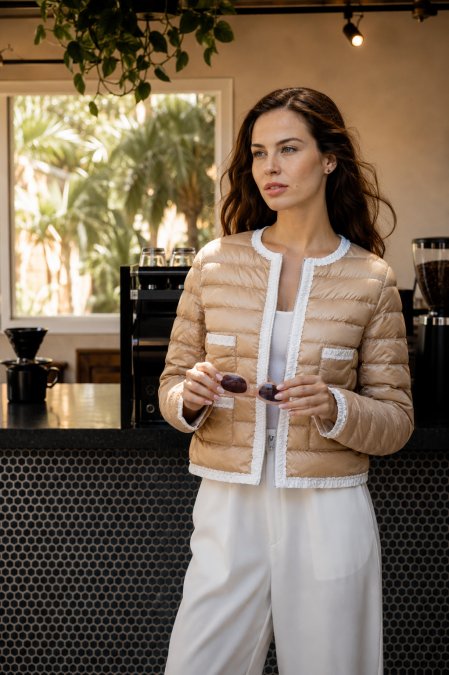
Compressibility is where down separates itself most clearly. Down clusters fold tightly and recover their loft when unpacked, which is why many down jackets pack into an internal pocket and take up a fraction of a carry-on. Polyester resists compression, so a synthetic jacket of similar warmth usually occupies more space.

For frequent travellers, this difference compounds: a jacket that flattens into a corner of a weekender bag leaves room for everything else. Cotes of London designs its down pieces with this in mind, and the The Senenne hooded down jacket uses lightweight nylon and RDS-certified down to keep bulk low without sacrificing warmth.
Performance in Damp Conditions and Drying Time
Polyester has an advantage when the weather turns wet. Synthetic fibres are hydrophobic, so polyester insulation generally retains more of its structure when damp and dries faster. Down loses loft when saturated because water collapses the clusters, so it works best with a water-resistant outer layer in wet conditions.
That does not make down unsuitable for damp weather. Water-repellent outer fabrics can help in light rain and snow, and a practical option for many travellers is layering: a down mid-layer under a weather-resistant outer piece.
Breathability and Moisture Management
Breathability and moisture management depend largely on the shell, lining, membranes and ventilation rather than on the fill alone. In practice, comfort during activity depends on the complete garment system and how it is layered.
Hypoallergenic Properties
Allergy responses are individual, and neither fill should be described as universally hypoallergenic. Anyone with a known sensitivity to feathers, dust or textile treatments should check the product details and seek appropriate medical advice if needed. Cotes of London uses RDS-certified down supplied by ALLIED Feather + Down, which states that its global supply chain is RDS-certified.
Drying Time in Practice
Polyester insulation generally dries faster than down, but drying time varies with the jacket's construction, fabric, amount of fill and care method. Down must be dried thoroughly so the clusters can separate and regain loft. Always follow the garment's care label and avoid higher heat than the manufacturer recommends.
For a down piece that layers well under a shell, the Senenne hooded down jacket uses lightweight nylon and RDS-certified down to keep bulk low while providing warmth that survives light moisture when paired with an outer layer.
How to Clean Down Jackets Without Losing Loft
Correct care helps a down jacket retain loft. Follow the garment's care label; where machine washing is permitted, use a gentle cycle and a suitable down detergent, avoid fabric softener and bleach, and rinse thoroughly. If tumble drying is allowed, use the recommended low setting and dryer balls to help separate clumps. Continue only until the jacket is completely dry.
Re-Lofting After Washing
After drying, gently shake the jacket and work any remaining clumps apart through the fabric. Allow it to air in a dry space and check that the fill is evenly distributed before storing it. The amount of loft recovered depends on the garment's condition and whether the care instructions were followed.
Responsible Down Standard Explained: What RDS Does and Does Not Certify
The Responsible Down Standard is a certification covering animal welfare and chain of custody in the down supply chain. It prohibits live-plucking and force-feeding, and requires traceability from farm to finished product (responsibledown.org). What RDS does not do is certify warmth, quality, durability or overall environmental impact. Those depend on fill power, construction, care and the wider manufacturing process, none of which the standard assesses.
Cotes of London uses down supplied by ALLIED Feather + Down, which helped develop the Responsible Down Standard and states that its global supply chain is RDS-certified. The distinction matters: a certification tells you how the down was sourced, not how warm the jacket will be. For a fuller explanation, see the Cotes of London guide to responsible down.
Durability, Cost, and Sourcing Compared
Durability varies with the quality of the insulation, shell fabric and construction, as well as how the jacket is worn, washed and stored. Down can retain loft for a long time when cared for correctly, while synthetic insulation can gradually lose loft through wear and compression. That does not support a fixed lifespan for either material. Neither option is inherently more sustainable: assess certified sourcing, recycled content, construction, care and expected use together.
Long-Term Degradation: What Happens After Five Years
Both down and polyester insulation can change with repeated wear, washing and compression. Down clusters may regain loft after careful cleaning and drying, while synthetic fibres can gradually flatten. The rate of change varies widely with materials, construction and care, so a five-year outcome cannot be predicted from the fill type alone. Choose a well-made jacket, follow its care label and avoid storing either insulation compressed for long periods.
Specific Cleaning and Re-Lofting Techniques
Polyester-filled garments are often simpler to care for, but instructions vary by shell fabric and construction. Follow the garment's care label, use only the permitted wash and drying settings, and avoid unnecessary heat or prolonged compression.
Ethical Sourcing vs. Recycled Synthetics
Recycled polyester reduces reliance on virgin petroleum and diverts plastic waste, but it can shed microplastics during washing, and its production still carries environmental costs. Neither option is universally better. The more useful question is whether the supply chain is transparent and the product is built to last. Cotes of London uses down supplied by ALLIED Feather + Down, which helped develop the Responsible Down Standard and states that its global supply chain is RDS-certified. For a fuller explanation, see the Cotes of London guide to responsible down.
Cost Over Time
Down often has a higher upfront price, while polyester insulation is frequently less expensive. The better value depends on the specific jacket's construction, how often it is worn and how well it is maintained; fill type alone cannot predict cost per year. Polyester may suit buyers who prioritise simpler care or lower initial cost, while down may suit travellers who value low weight and packability.
For a down piece built around travel and everyday wear, the Knightsbridge reversible down coat offers two looks in one, while the Dorchester down coat takes a more structured A-frame approach. Care guidance for down pieces is covered in the Cotes of London down care guide.


Which Insulation Suits Your Jacket?
Match the fill to the conditions you actually dress for. Down suits cold, dry climates, long-haul travel and anyone who wants warmth without weight. Polyester suits wet weather, high-intensity use and buyers who prefer low-maintenance care. Many wardrobes benefit from both, layered according to the forecast.
For a down piece built around travel and everyday wear, the Knightsbridge reversible down coat offers two looks in one, while the Dorchester down coat takes a more structured A-frame approach. Care guidance for down pieces is covered in the Cotes of London down care guide.
Frequently Asked Questions
How does down insulation perform in wet weather compared to polyester?
Down loses loft when it gets soaked, which reduces its insulating ability until it dries. Polyester fill absorbs very little water and keeps more of its structure when damp, so it can feel warmer in sustained wet conditions. In light showers, a water-repellent outer fabric protects down well enough for everyday wear. For heavy rain, a synthetic fill or a waterproof shell over a down layer is the more practical choice.
Is down or polyester better for frequent travel and packing?
Down usually packs smaller for a given warmth because it has a higher warmth-to-weight ratio. Polyester is typically bulkier but can be a practical choice where quicker drying and simpler care matter more. If space and weight are priorities, down often has the edge; choose the specific jacket based on construction, care instructions and expected conditions.
What does RDS certification actually guarantee for down products?
The Responsible Down Standard covers animal welfare and chain of custody. It prohibits live-plucking and force-feeding and requires traceability from farm to finished product. It does not certify warmth, quality, durability, or overall environmental impact. Cotes of London uses RDS-certified down supplied by ALLIED Feather + Down, which helped develop the standard and states its global supply chain is RDS-certified.
How should I care for down versus synthetic insulated outerwear?
Care requirements vary by garment. Follow the care label for both down and polyester insulation. Where washing is permitted, use the recommended detergent, cycle and drying method; avoid fabric softener on down and avoid higher heat than the manufacturer allows. Store either fill clean, completely dry and without prolonged compression.
The choice between down and polyester comes down to climate, travel habits and how much maintenance you want to take on. Cotes of London uses down supplied by ALLIED Feather + Down; the Senenne product page identifies RDS-certified down, OEKO-TEX® certified fabric and WRAP-certified production. Explore the Cotes of London down collection to find a lightweight layer for city days and travel.